
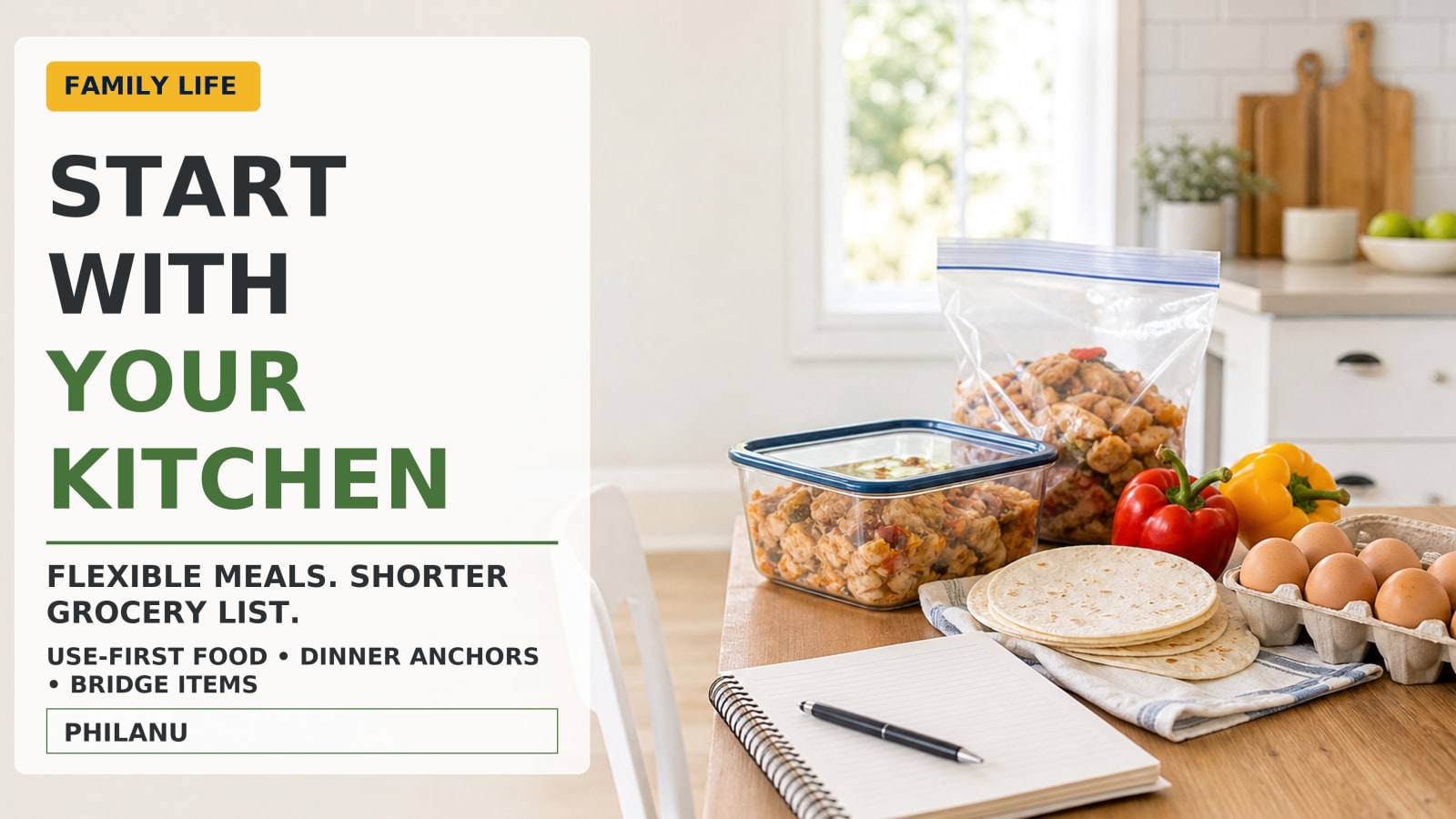
To meal plan with what you already have, start by assigning the most perishable food to two realistic dinners, reserve one easy backup, and buy only the small gaps that make those meals workable. A short plan beats a full inventory you will not use.
A full refrigerator can still produce the familiar 5:30 p.m. feeling that there is nothing for dinner. There may be cooked chicken behind the milk, spinach that needs attention, half a package of tortillas, leftover rice, frozen broccoli, eggs, and a few sauces. Those are ingredients, not yet a decision.
This reset is built for the week that is already happening: school events, late meetings, selective eaters, and the occasional night when takeout wins. It has three milestones. First, identify the food that needs a destination. Next, make a few dinner commitments that fit the actual calendar. Last, shop only for the pieces that connect the plan.
Start with the tradeoff, not the recipe
Recipe-first meal planning can be useful when someone enjoys cooking and has a predictable week. It is a poor fit when the kitchen already holds food that needs using or the schedule has little room for a complicated plan. In that situation, the better choice is an ingredient-first plan.
Before deciding what to cook, judge each possible meal against three practical criteria:
- Urgency: Does it use food that is opened, cooked, delicate, or otherwise likely to be forgotten?
- Realism: Can this meal happen on the night assigned, with the time and energy your household is likely to have?
- Flexibility: Can it survive a missing ingredient, a changed plan, or different preferences at the table?
A meal that looks efficient on paper but requires a 45-minute cooking window on the evening of a school concert fails the realism test. A meal that uses urgent food but leaves a child with nothing familiar to eat fails the flexibility test. The aim is not to use every item in the house. It is to make the next grocery trip smaller without making dinner harder.
That approach matches federal consumer guidance: MyPlate recommends checking the refrigerator, freezer, and cabinets before planning meals, then building a grocery list around what is genuinely needed. The FDA also advises households to plan meals, use a list, and avoid buying more food than they can use before it spoils.
Milestone 1: Give the soonest food a visible job
Set a timer for 10 minutes. Open the refrigerator and look only for food that is already cooked, opened, cut, thawed, or fragile enough that it could vanish into the back of a shelf. Then glance at the front of the freezer and the pantry for opened packages that could support a meal.
Do not make a complete inventory. A complete inventory is useful only if your household will maintain it. For this reset, write a short use-first note with three headings:
- Cook or serve soon: items that should be assigned to the earliest workable meal.
- Useful later: freezer, pantry, and sturdier refrigerator foods that can carry a later meal.
- Check before using: food with uncertain storage, an unknown timeline, or signs that it may be spoiled.
The third heading prevents a common mistake: treating meal planning as a reason to stretch food past a safe point. Except for infant formula, many package dates are about quality rather than a federally required safety deadline. But a date is only one part of the decision. Storage history, package instructions, and signs of spoilage still matter. The FDA directs consumers to use storage guidance and assess food carefully rather than relying on date labels alone.
Suppose the use-first note contains cooked chicken, spinach, six tortillas, two bell peppers, cooked rice, shredded cheese, eggs, salsa, and frozen broccoli. Chicken and spinach are the first priority if they were handled and refrigerated safely. Rice, tortillas, eggs, broccoli, cheese, and salsa are support players. They make it possible to build dinners without buying another protein simply because a new recipe called for one.
If there is a container you cannot identify or remember handling, do not build the week around it. FoodKeeper and the federal cold-storage chart can help with common foods, but uncertainty about temperature or time is a reason to be cautious. Saving groceries is worthwhile; gambling on food safety is not.
Milestone 2: Make only the dinner promises your week can keep
Many families do not need seven assigned dinners. They need two or three dependable dinner anchors, a plan for leftovers, and a backup that does not require a new burst of energy. Leaving several nights open is not a planning failure. It is how the plan survives a busy week.
Choose dinner formats rather than strict recipes. A format gives the ingredients a job while allowing substitutions: tortillas with fillings, grain bowls, pasta with vegetables and a protein, soup with sandwiches, baked potatoes, breakfast for dinner, or a sheet-pan meal. Use the criteria from the first section to decide which formats belong this week.
For the example kitchen, an early-week tortilla dinner could use chicken, spinach, peppers, cheese, and salsa. Later, rice bowls with eggs and broccoli use foods that can wait a little longer. A familiar freezer or pantry dinner becomes the backup, not a sign that the plan went wrong.
Put the fragile meal on the first realistic night
“First realistic” matters more than “first night of the week.” If Monday includes a late practice and Tuesday is quieter, Tuesday may be the proper place for chicken and spinach. If both evenings are packed, freezing an appropriate ingredient promptly may be the safer, less wasteful choice than repeatedly moving it down the calendar.
MyPlate advises planning around available time and using a mix of fresh, frozen, and shelf-stable foods. That makes a sound household rule: use the fresh food when there is a credible chance of cooking it; let freezer and pantry foods handle the nights with less certainty.
A realistic family scenario
Scenario: Wednesday changes at 4 p.m. The plan was chicken tortillas, but one parent is delayed and a child needs to leave again in 35 minutes. The reset is not to rush through the original meal because it was written down. Check the chicken first. If it can be safely held for tomorrow and tomorrow is open, move it. If not, freeze it if appropriate, then make the backup dinner.
That is a successful plan because it protects the ingredient and avoids turning a difficult evening into two separate dinners. It also leaves a usable next step instead of a vague promise to “catch up” tomorrow.
When preferences split, keep one shared base and serve additions separately. Tortillas and cheese may be familiar for everyone, while chicken, spinach, peppers, and salsa stay in separate bowls. Rice bowls work the same way. One person can have rice and egg; another can add broccoli and sauce. That is one dinner structure with room for individual needs, not a second entrée.
For food allergies or medically necessary diets, continue established practices for ingredient separation and cross-contact prevention. A plan to reduce waste should never override a household’s safety requirements.
Milestone 3: Shop for bridges, not replacements
A bridge item is a small purchase that makes the food at home usable. It might be milk for breakfasts, fruit for lunchboxes, bread for sandwiches, or the one missing piece of a backup meal. Its value is not that it is cheap; its value is that it connects food you already own to meals your family will eat.
Give every item on the grocery list one job before it goes into the cart:
- It completes one of the planned meals.
- It replaces a staple that will truly run out before the next shopping trip.
- It solves a specific breakfast, lunch, or schedule problem already visible this week.
If an item has no job, it can wait. This is particularly useful when a sale or bulk package feels like a bargain but would add more produce, dairy, or protein to a kitchen that is already full. The FDA specifically warns that impulse and bulk purchases can create waste when they exceed a household’s normal needs or preferences.
For the example week, a bridge list might contain fruit for lunches, milk if the household is low, and one item for the backup dinner. It does not automatically need more meat. Chicken, eggs, and frozen food already cover the meals that have been chosen.
Large packages deserve a separate decision. A lower unit price is useful only when the food has a believable destination before quality drops or storage becomes a problem. Use this family bulk-buying test when a warehouse-size package looks tempting but your use-first list is already long.
When the plan changes, protect the food before rewriting the calendar
A skipped meal is not a debt. Do not try to force it into the next day alongside the meal already planned. Instead, decide what happens to the ingredients: refrigerate them safely for a near-term meal, freeze them if appropriate, turn them into lunch, or let the plan go if the food is no longer suitable.
Leftovers benefit from the same directness. Give them a destination while putting them away: tomorrow’s lunch, quesadilla filling, a grain-bowl base, or a labeled freezer portion. USDA guidance says most cooked leftovers held safely in the refrigerator should be used within three to four days. If no one is likely to eat them in that period, freezing them earlier is usually more sensible than hoping they will become appealing later.
For safety, keep the refrigerator at 40°F or below and the freezer at 0°F or below. Perishable foods should not remain at room temperature longer than two hours, or longer than one hour when the temperature is above 90°F. Shallow, covered containers help leftovers cool promptly and make them easier to see the next day.
If you thaw food for a revised plan, use one of the safe methods identified by USDA: the refrigerator, cold water, or a microwave. Food thawed in cold water or a microwave needs prompt cooking. Counter thawing is not a workaround for a late start.
Carry forward evidence, not guilt
Before the next grocery run, spend two minutes looking at what remains. Maybe the rice bowls were easy enough to repeat. Maybe the backup dinner was essential. Maybe the spinach was still untouched because the early-week schedule was too crowded, which is useful evidence that delicate food needs an even earlier assignment or a smaller purchase next time.
This is the milestone that makes the system easier over time. You are not trying to produce a flawless weekly calendar. You are learning which foods your household uses, which dinner formats hold up under pressure, and which grocery purchases create more work than they solve. Start the next plan with those answers already in the kitchen.
About this guide
Useful, people-first, practical content for U.S. families. Prioritize SAVE MONEY and TRAVEL when commercially appropriate.
This page separates sourced facts from estimates and examples, states important limitations, and passes separate editorial and publishing checks before it is posted. It is general information, not individualized professional advice.