
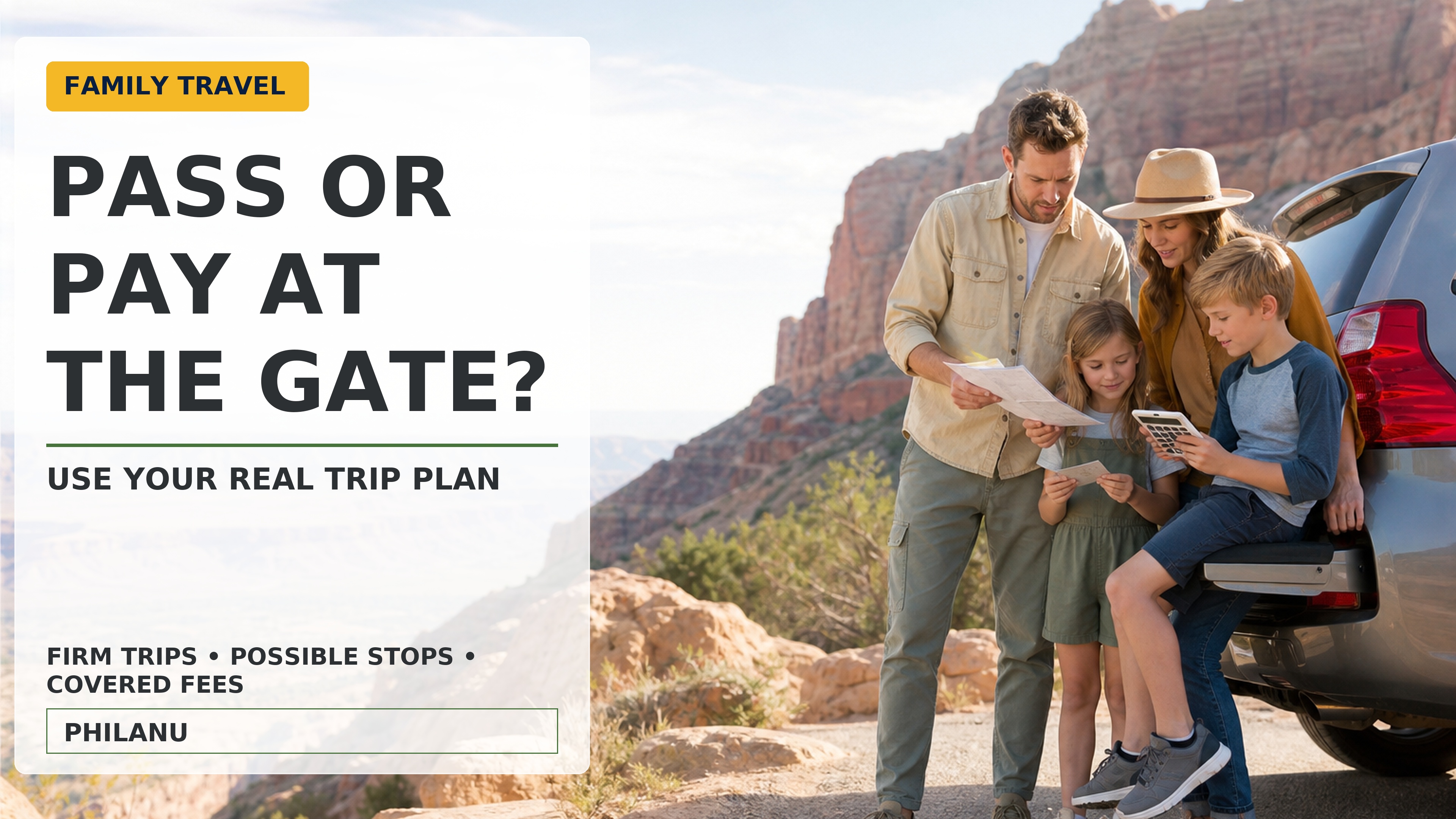
For a family with a U.S. citizen or resident passholder, the $80 America the Beautiful annual pass is worth buying when covered entrance and standard day-use fees on trips you are genuinely likely to take exceed its total purchase cost. Compare free, discounted, and park-specific passes first.
The arithmetic is easy. Deciding which trips belong in the arithmetic is harder. A weekend that is booked should not carry the same weight as a park someone mentioned over dinner, and a campground charge does not become pass savings merely because it appears on the same checkout screen.
Start with the cheapest pass your group can use
As of January 1, 2026, the resident America the Beautiful annual pass costs $80 and is available to U.S. citizens and residents. At sites that charge by vehicle, it covers the passholder and passengers in one private, noncommercial vehicle. At per-person sites, it covers the passholder and three additional adults.
Do not put $80 at the top of the worksheet until checking whether a traveler qualifies for another America the Beautiful pass:
- Fourth Grade Pass: A U.S. fourth grader can obtain a free Every Kid Outdoors pass. Its program year runs from September 1 through August 31, and the student must be present when the pass is used.
- Senior Pass: U.S. citizens and permanent residents age 62 or older can buy a $20 annual pass or an $80 lifetime pass.
- Military passes: Free annual or lifetime passes are available to specified current military members, dependents, veterans, and Gold Star Families.
- Access or Volunteer Pass: A free lifetime Access Pass may be available to an eligible person with a permanent disability. Federal recreation volunteers can qualify for a free pass after 250 service hours.
Documentation and coverage rules differ. Confirm eligibility on the official National Park Service pass page rather than relying on a travel forum or an old screenshot.
There may also be a cheaper pass for one park or a small regional group. Zion National Park, for example, lists a $70 Zion annual pass for U.S. citizens and residents. That is the better price for repeated Zion visits with no other paid federal recreation stops. Once another covered site enters the plan, the broader $80 pass deserves another look.
Build the worksheet around trips, not destinations
A useful worksheet has one row for each separate visit. Record the expected date, entry method, fee without an annual pass, and how certain the trip is. A five-day stay usually belongs on one row because standard park entrance passes commonly cover a visit of up to seven days.
Step 1: Write down the real pass cost
Use the amount you would actually pay. The base price is $80 for an eligible resident annual pass, but a mailed physical pass may involve checkout costs. A digital pass can be used immediately, while the National Park Service advises allowing up to three weeks for a physical pass ordered by mail.
Annual pass cost (A) = $_____
Step 2: Total the firm trips
Count a trip as firm when the dates, transportation, and lodging or day-trip plan are settled enough that the family expects to go even without an annual pass. Enter only the entrance or standard day-use fee the pass would remove.
Covered fees for firm trips (B) = $_____
Step 3: Keep possible trips separate
Give tentative stops their own subtotal. This keeps an appealing but fragile itinerary from making the pass look cheaper than it is.
Covered fees for possible trips (C) = $_____
Step 4: Compare the two answers
Firm-trip result = B − A
Full-plan result = B + C − A
- If B is greater than A, the pass pays for itself on firm trips.
- If B + C is less than A, separate entrance passes cost less even if every possible trip happens.
- If A falls between those totals, the decision depends on how likely the additional trips are and when the first entrance fee must be paid.
A three-park family scenario
Consider a hypothetical family traveling in one private vehicle. No one qualifies for a free or discounted pass. Zion and Bryce Canyon are booked, while a Grand Canyon stop is still being discussed. Each park lists a $35 private-vehicle entrance fee.
Swipe sideways to view every column.
| Park | Status | Fee | Count now |
|---|---|---|---|
| Zion | Booked | $35 | $35 |
| Bryce Canyon | Booked | $35 | $35 |
| Grand Canyon | Possible | $35 | $0 |
The firm-trip total is $35 + $35 = $70. On those two visits alone, separate entrance passes cost $10 less than the $80 annual pass.
If Grand Canyon becomes firm before the first park entry, the total rises to $105. The annual pass would then save $25 on the three entrance fees.
That timing matters. Once an entrance fee has been paid, do not automatically subtract it from a later annual-pass purchase. Some parks publish procedures for applying recent entrance receipts toward an upgrade, but this should not be assumed systemwide. Confirm the policy at the park that collected the fee before counting any credit.
Price an uncertain trip instead of pretending it is booked
Families comfortable using expected-cost math can calculate how likely the possible trip must be before buying the pass makes financial sense. The formula is:
Break-even probability = (pass cost − firm fees) ÷ possible covered fee
For the three-park example:
($80 − $70) ÷ $35 = 0.286, or about 29%
If the family believes there is more than a 29% chance it will visit Grand Canyon during the pass period, the annual pass has the lower expected cost before the first entrance fee is paid. That does not guarantee a saving. The actual outcome will still be either $70 for two parks or $105 for three.
A household that dislikes paying for unused plans may reasonably set a stricter rule: buy only when the additional trip is confirmed. The probability calculation prices the uncertainty; it does not decide how much uncertainty a family should accept.
Remove costs the annual pass will not erase
The America the Beautiful pass is not an all-inclusive vacation ticket. It covers federal entrance fees and qualifying standard amenity day-use fees. Keep these items out of the savings total unless the official site page explicitly says the pass covers them:
- Camping and lodging
- Timed-entry or reservation charges
- Special tours and activity permits
- Concession-operated transportation or attractions
- Food, equipment rentals, and retail purchases
- Commercial tour charges that do not accept the pass
Also enter $0 for a fee-free site or a qualifying fee-free visit. Most National Park Service locations do not charge an entrance fee, so the number of park units on an itinerary can be a poor shortcut for estimating savings.
Check how the family will enter
Vehicle pricing is where the pass often becomes attractive for families. At a park charging one private-vehicle fee, do not multiply that fee by the number of passengers. A family of four arriving together may owe the same $35 entrance fee as a couple in another car.
The calculation changes when visitors arrive on foot, by bicycle, on motorcycles, in a large organized group, or through a commercial tour. Children may also be treated differently from adults at per-person sites. Use the fee for the actual entry method shown on the park's current page.
If relatives will split between two cars, check the coverage carefully. One pass normally covers one qualifying private vehicle at a time, not every vehicle associated with a family reunion.
Non-U.S. visitors need a different worksheet
The $80 calculation applies only when the passholder is eligible for the resident price. Beginning January 1, 2026, the America the Beautiful Non-Resident Annual Pass costs $250.
Non-U.S. residents age 16 and older also face an additional $100-per-person fee at 11 specified national parks, including Zion, Bryce Canyon, and Grand Canyon, unless they are admitted with a qualifying annual pass. For those families, the nonresident pass can reach its break-even point much faster, but the worksheet must begin with $250 and include the applicable per-person charges.
Run these checks before paying
- Verify each current fee on the official page for that park or federal recreation site.
- Remove visits outside the pass's stated validity period.
- Check eligibility-based and park-specific passes before comparing standard fees.
- Make sure reservations or permits are available; the annual pass does not create access to a sold-out time slot.
- Choose a passholder who expects to be present and can show the required identification.
- Decide before paying the first entrance fee unless an upgrade policy has been confirmed.
America the Beautiful passes are listed as nonrefundable and nontransferable, so buying months early for an unfinished itinerary carries a real downside. If the firm fees have not crossed the line, leaving the money in the travel budget is a perfectly sound result.
Make the pass follow the trip
The cleanest decision is made from the itinerary the family already wants: compare its covered fees with the cheapest pass the group can legitimately use. Buy when those numbers cross. There is no need to add another weekend on the road simply to make an $80 purchase feel successful.
Sources reviewed: (checked 2026-09-06)