
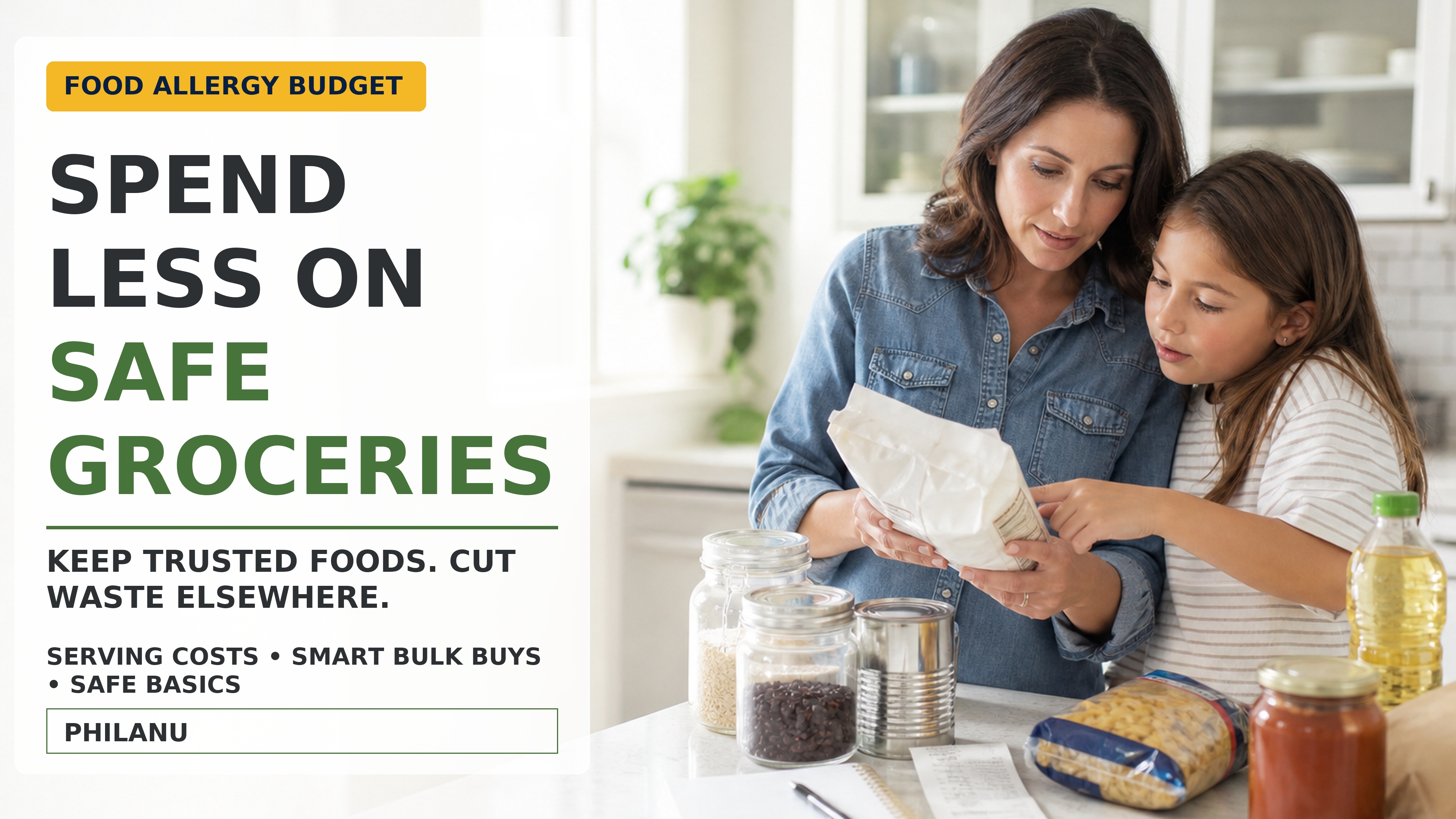
Keep a trusted product when replacing it could compromise the family’s safety plan or create likely waste; target the rest of the cart first. Review any premium substitute used three or more times a week, then compare its cost per eaten serving with an already-approved meal format.
The three-times-a-week test is a budgeting trigger, not a medical threshold. It identifies purchases large enough to examine without encouraging risky brand switching. A specialty food may stay protected; the saving can come from serving it less often, changing the meal around it, or reducing waste.
That approach differs from ordinary bargain shopping. Switching brands freely, buying the largest package, or planning dinner entirely around a sale can create extra label work and unacceptable uncertainty. The goal is not the cheapest possible cart. It is a safe cart with fewer expensive habits hiding inside it.
This is general budgeting guidance, not medical advice. Continue following the avoidance and cross-contact plan provided by your allergist or another qualified clinician. Any food mentioned here is an example, not a recommendation for a particular allergy.
Use three filters in the same order
Judge a possible grocery change by safety, actual use, and total cost—in that order. First, decide whether the food satisfies the household’s established allergy plan. Then ask whether it will reliably be eaten in the intended meals. Only products that pass both checks should compete on price.
Total cost includes more than the number on the shelf tag. Package waste, an extra store trip, special storage, and additional ingredients required to finish the recipe can turn an apparent bargain into the more expensive choice.
This order also removes pressure to justify every trusted product. If one bread, lunch-box snack, or emergency meal works consistently, protecting it may be sensible. The rest of the menu can carry more of the savings work.
Do not replace the old menu item for item
A newly restricted menu often produces a long chain of direct replacements: specialty bread for bread, dairy-free cheese for cheese, allergen-friendly cookies for cookies, and a boxed mix for every recipe that used to start with flour.
Some replacements are worth paying for. A dependable school snack or a bread the family consistently eats may solve a real problem. Trouble starts when every familiar dish requires two or three premium products before it reaches the table.
Look at the whole meal before adapting it. Tacos that require one trusted specialty item may remain affordable. A casserole that needs specialty noodles, a cheese alternative, a milk alternative, bread crumbs, and a replacement soup base is a stronger candidate for retirement.
No one needs to turn dinner into a punishment. Keep the substitutes that protect convenience, nutrition, participation, or genuine enjoyment. Replace the meals whose cost is mostly an attempt to reproduce an old recipe exactly.
Give every purchase a spending lane
A single savings rule does not fit the entire cart. Sort recurring purchases by how much flexibility the household actually has, then concentrate bargain hunting where a substitution is both safe and useful.
| Lane | Typical purchase | Shopping rule |
|---|---|---|
| Protected | Trusted daily essential | Keep the vetted product |
| Flexible | Several approved choices | Compare serving costs |
| Basic | Safe meal ingredient | Plan around prices |
| Optional | Treat or new substitute | Buy selectively |
The protected lane should be short. It might include a particular bread, formula, lunch-box item, or emergency convenience meal. Trying to save 40 cents on something the family depends on can consume more time and attention than the possible saving deserves.
Flexible products are different. If the household has already approved several pasta shapes, broths, cereals, or frozen vegetables, price can decide among them. Basic ingredients offer even more room: choose meals around the safe rice, potatoes, beans, meat, produce, or other staples that are affordable that week.
An expensive trusted product is not automatically wasteful. A cheaper product that fails the household’s safety review or sits uneaten in the pantry is not a bargain.
Calculate the cost of the food that gets eaten
Package price is a poor comparison when specialty products have different sizes, serving counts, or rates of waste. Price the amount used for one breakfast, lunch, or dinner instead.
Hypothetical lunch calculation
Suppose a vetted specialty loaf costs $7.49 and provides enough bread for the family’s weekly sandwich lunches. A package of already-approved tortillas costs $3.29 and can replace half of those sandwiches with wraps or another familiar lunch format.
- Two loaves each week: $14.98
- One loaf plus one tortilla package: $10.78
- Weekly difference: $4.20
Using 52 weeks divided by 12 months, that change is about $18.20 per average month. These prices are hypothetical; the useful part is the calculation. The family keeps the trusted bread but changes how often it is needed.
The same method works for cereal, milk alternatives, crackers, baking mixes, and packaged snacks. Divide the price by the number of servings the household realistically eats—not an optimistic serving count based on a plan that never survives the week.
Approve the product before comparing the price
For most packaged foods under its jurisdiction, the U.S. Food and Drug Administration requires the food source of a major allergen used as an ingredient to be identified on the label. The agency’s food allergy labeling overview also explains that advisory statements such as “may contain” and “produced in a facility” are voluntary.
Those phrases do not form a dependable ladder of risk. The FDA has said that a facility statement is not necessarily different from a “may contain” statement in the likelihood of cross-contact or the possible allergen level. Its food allergen landscape discussion provides additional context.
Follow the household’s clinical guidance on precautionary labeling rather than assuming softer wording means a safer product. Read the entire ingredient information every time, including on familiar packages, because formulations can change. The FDA advises leaving a product out or contacting the listed manufacturer or distributor when its contents are unclear, as explained in its consumer label guidance.
The shopping sequence is straightforward: safety review first, household fit second, price comparison third. Coupons and store brands can still help, but only after the first two questions have been settled.
Bulk prices count only when the food gets used
A warehouse label may show the lowest cost per bar, ounce, or pouch. That calculation silently assumes the entire package will be eaten before the food expires, goes stale, or falls out of favor.
Consider a hypothetical 24-count box of vetted snack bars priced at $18. The shelf calculation is 75 cents per bar. If eight remain uneaten, however, the household spent $18 for 16 consumed bars. The usable cost rises to $1.13 per eaten bar.
A six-count package costing $5.40 works out to 90 cents per bar. If all six are eaten, the apparently expensive small box costs less per usable serving.
Large packages make sense when the product has already passed the household’s review, has been finished consistently before, and can be stored without creating a cross-contact problem. Check the expiration date and the effect on this week’s cash as well. A good unit price can strain a tight grocery budget if it ties up money needed for other meals.
For an unfamiliar replacement, buy the smallest practical size. A trial package with a higher unit cost is often cheaper than a pantry full of something nobody wants twice.
Put a price on the extra store stop
Some families need more than one grocery source because no single store carries every trusted product. Even so, a weekly circuit of several stores can erase part of the apparent saving through fuel, pickup charges, time, and unplanned purchases.
Set a personal detour rule before a sale appears. A separate trip might need to save a chosen dollar amount, secure several weeks of a protected product, or fit beside an errand already on the calendar. The threshold will vary by distance, transportation, and schedule; deciding at home is easier than trying to reason it out in response to an advertisement.
For example, a parent who sees a $1 discount on trusted crackers across town could check how many packages the family will use before the best-by date, subtract the cost of the trip or pickup fee, and ask whether the stop displaces anything else that evening. If the net saving is small, adding the crackers to the next planned order may be the calmer choice.
Online shopping carts are useful comparison tools even when the final purchase happens in person. Enter the same short list at two stores, compare the totals, and check package sizes. Similar boxes are not always equivalent quantities.
For many households, one main store plus an occasional specialty order is easier to control than chasing the lowest price on every line of the list.
Build dinners from safe formats, not rigid recipes
A rigid recipe can trigger an expensive hunt for the exact substitute needed at each step. A meal format starts with foods the household already knows how to use safely and leaves room for the week’s prices.
Write down several repeatable formats drawn from the family’s existing safe-food list. Depending on that list, possibilities could include a grain bowl, soup, tacos, a baked-potato meal, breakfast for dinner, simple pasta, or a sheet-pan supper. Each format needs a filling base, a substantial component, and enough produce, seasoning, or sauce to make it a complete meal for that household.
This is not a universal list of allergy-friendly foods. It is a way to organize ingredients already approved for one family. When a usual item is unavailable or unusually expensive, the format can bend without forcing a complete menu rewrite.
Watch for dinners that stack several premium replacements on one plate. If a meal includes specialty bread, a cheese alternative, a separate convenience side, and a packaged dessert, move one or two of those foods elsewhere in the week. Variety remains; the premiums stop arriving all at once.
Track only the prices that can change the bill
A detailed price book for every grocery item quickly becomes unpaid administrative work. A short watch list is more likely to survive.
Choose roughly eight to twelve recurring purchases: protected essentials, frequently used specialty foods, and flexible staples with noticeable price swings. Record the store, package size, regular price, and the price that would justify buying one extra package.
- Trusted bread: price and usable slices per loaf
- Milk alternative: cost per quart or fluid ounce
- School snack: cost per piece the child will eat
- Specialty pasta or flour: price per ounce
A phone note is enough. Review a receipt once a month rather than updating the list in the aisle. Over time, it becomes clear which promotions are unusual and which “sales” return so often that there is no reason to stock up.
Check benefit rules before paying another way
Allergy-friendly marketing does not by itself make a grocery item ineligible for SNAP. USDA guidance says SNAP can generally buy household foods such as breads, cereals, produce, meat, dairy products, snacks, and nonalcoholic beverages. A product carrying a Supplement Facts label is treated as a supplement rather than an eligible food.
The USDA’s SNAP purchase guidance explains the broader rules. If an apparently eligible food is rejected at checkout, ask the retailer or state SNAP agency to help identify the issue rather than assuming all specialty foods are excluded.
Make one change at the next grocery trip
Start with three short lists: products that must stay protected, premium substitutes that appear frequently, and safe pantry or freezer foods that should be used soon.
Choose one costly item used at least three times during a normal week and calculate what it adds to actual meals. The next move may be to serve it less often, buy a smaller package, reserve it for the meal where the family values it most, or alternate it with another option that has already been approved.
Keep the safety standard fixed. Change the meal format, serving frequency, package size, store, convenience level, or amount of waste around it. That is where an allergy-aware grocery budget has room to bend.
Sources reviewed: (checked 2026-09-05)