
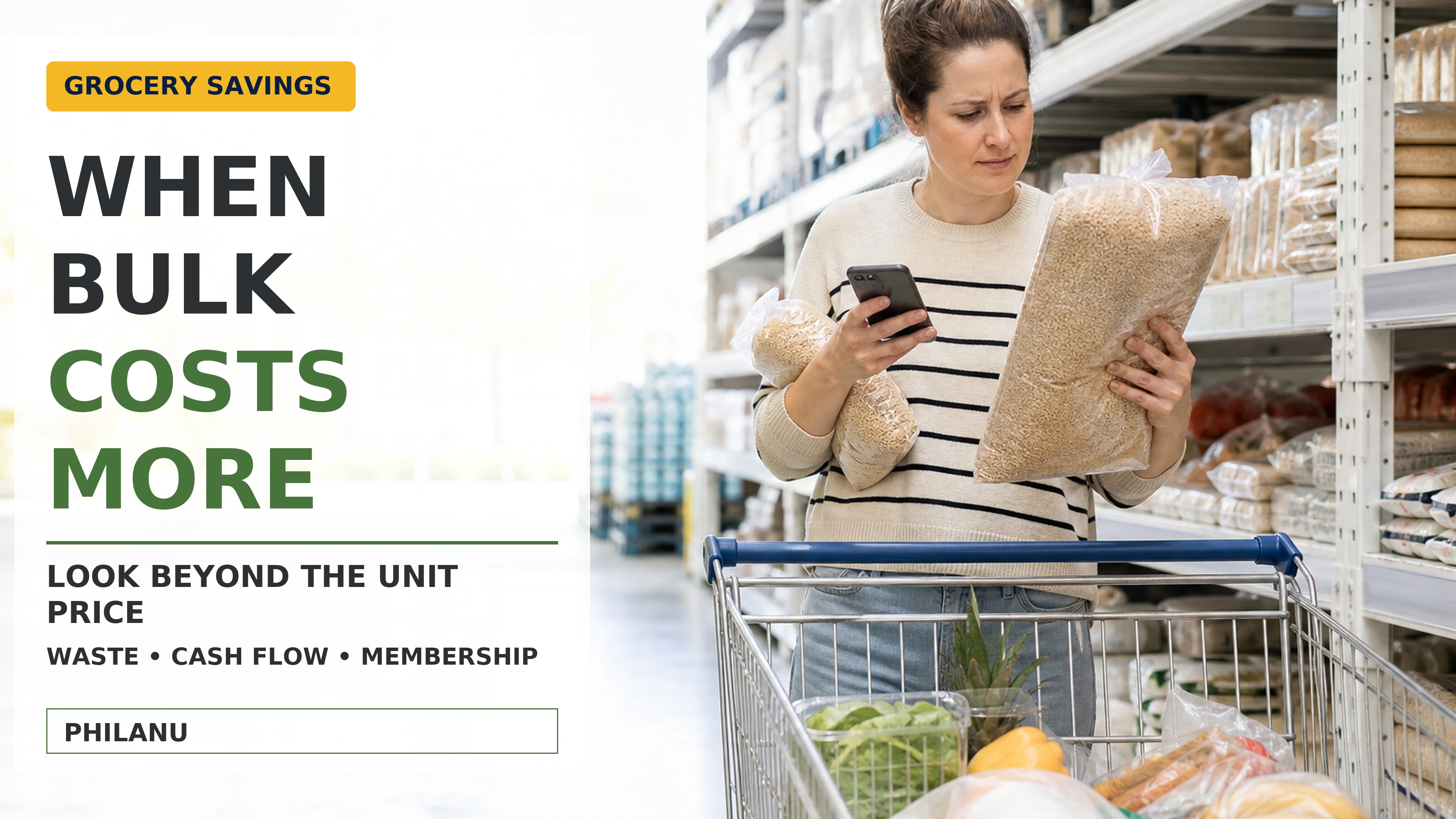
A bulk package saves money only when its lower unit price survives the trip home: the household uses enough of it, storage protects it, the larger checkout total fits the current budget, and any membership fee is recovered. Miss one condition, and the apparent bargain can cost more.
The problem is easy to picture. A large container of snacks costs less per ounce, but the children lose interest halfway through it. The remainder goes stale. The smaller package had the higher shelf price and the lower household cost.
Shelf tags answer one narrow question: how much product does a dollar buy? They cannot predict how much will be eaten, where it will be stored, or what the extra spending means before the next paycheck.
Six familiar claims, with the missing conditions
| Claim | Failure point | Better test |
|---|---|---|
| Bigger is cheaper | Unit price may rise | Match the units |
| Low unit price means savings | Some goes unused | Find break-even use |
| Big families should buy bulk | Demand varies | Check use rate |
| Perishables are poor buys | Some freeze well | Plan portions first |
| Future savings always win | Cash is tied up | Protect this month |
| Membership pays for itself | Fee exceeds savings | Calculate break-even |
Each claim contains a useful idea. Trouble starts when that idea is treated as a rule with no exceptions.
The biggest package may not have the lowest unit price
Package size is not proof of value. A supermarket promotion, store brand, digital coupon, or different product concentration can make the smaller option cheaper per ounce, sheet, load, or serving.
NIST's 2025 unit-pricing guide treats unit prices as a comparison tool and encourages consistent, readable displays. Federal law does not impose one nationwide unit-pricing requirement, so availability and presentation can vary. A shelf may show mismatched units, or no useful unit price at all.
When the labels are unclear, calculate it:
Package price ÷ package quantity = unit price
Consider a hypothetical comparison. A 28-ounce item priced at $7.56 costs 27 cents per ounce. A 40-ounce package at $10.40 costs 26 cents per ounce. The larger size is cheaper by one cent per ounce, but it requires another $2.84 at checkout and saves only 40 cents across 40 ounces at those unit rates.
That may still be worthwhile for a staple. It is not a dramatic bargain.
Use the same measurement and compare similar products. A bulk pack from a premium brand can cost more than a standard-size store brand. Detergent should be compared by realistic loads, not bottle size alone. With paper towels, sheet dimensions can matter as much as the number of rolls.
A lower unit price does not account for waste
The shelf calculation assumes every ounce has equal value. The pantry often proves otherwise.
Here is a hypothetical example. A 12-ounce package costs $3.29, or about 27.4 cents per ounce. A 40-ounce package costs $8.80, or 22 cents per ounce. The bulk package appears to win comfortably.
There is a more useful question: how much of the large package must be used before it becomes cheaper than buying the same usable quantity at the smaller package's rate?
Bulk price ÷ smaller package unit price = break-even quantity used
In this example, $8.80 divided by roughly 27.4 cents equals about 32.1 ounces. The household must use just over 80% of the bulk package. If 10 ounces spoil or go stale, the family consumes only 30 ounces and pays about 29.3 cents for each usable ounce. The supposed bargain is now the more expensive choice.
This is not an official waste threshold. It is a household calculation based on the two prices being compared. A narrow unit-price advantage leaves little room for waste; a large advantage can tolerate more.
The FDA advises shoppers not to buy more food than they can use before it spoils and specifically cautions against impulse bulk purchases of short-lived produce and dairy. New flavors, bakery trays, dips, berries, and snacks tied to a passing preference deserve a stricter waste estimate than rice or a familiar canned staple.
Household size is less useful than a four-week use rate
A family of six may finish food quickly, but head count is only a rough clue. Predictable consumption is the stronger signal.
Two people who eat oatmeal every morning may use a large container without trouble. A five-person household may abandon a case of flavored yogurt because only two people like it or because lunch routines change.
Before stocking up, check what actually left the pantry during the previous four weeks:
- How many packages or servings were finished?
- Was that use typical, or driven by a party, school break, guests, or another temporary event?
- Does opening the package shorten its useful life?
- Would the household still choose this product if a large supply were not already sitting there?
A purchase is easier to forecast when the item is used steadily and substitutions are unlikely. Trash bags, frequently used toiletries, familiar canned foods, and basic pantry ingredients often fit that description. Predictable demand prevents overbuying, but the unit price still needs checking.
Perishables are not automatically poor bulk buys
Meat, bread, cooked meals, and some produce can work in large quantities when they freeze well and are portioned promptly. The freezer is not a rescue plan for food that has already spent several questionable days in the refrigerator.
USDA guidance says food held continuously at 0°F remains safe indefinitely, although flavor and texture can deteriorate. Safety after thawing still depends on proper handling. USDA also notes that foods such as lettuce, mayonnaise, and cream sauces generally do not freeze well, which is a quality problem even when freezing itself is safe.
Before placing a perishable bulk item in the cart:
- Confirm that the food keeps acceptable texture after freezing.
- Make sure there is open freezer space now.
- Divide the food into meal-size portions using appropriate airtight packaging.
- Label each portion with its contents and freezing date.
- Use current USDA or FoodKeeper guidance for refrigeration, freezing, and thawing.
Packaging, containers, electricity, and the possibility of food being forgotten are real costs, though they do not automatically cancel the savings. A freezer plan is convincing when it names the portions and meals, not merely the intention to “use it someday.”
Long-run savings can still be wrong for this month's budget
A household can come out ahead over several months and still make a damaging purchase this week.
Suppose, hypothetically, that four bulk packages cost $74 while the smaller quantities needed before the next paycheck cost $31. Buying ahead might save $12 over time, but it also commits an additional $43 today.
If that $43 leads to a credit card balance, a late bill, or money being pulled from an emergency fund, the timing has weakened or erased the benefit. Housing, utilities, medicine, transportation, and required debt payments take priority over stocking the pantry at an attractive unit price.
One practical workaround is a small stock-up category within the grocery budget. Let unused money carry forward until it can cover a proven staple without squeezing the rest of the month. This also creates a natural limit: when the category is empty, the bulk purchase waits.
A warehouse membership needs its own break-even test
A paid membership is a separate cost. Large packages do not make that fee disappear.
As listed on Costco's U.S. website on September 7, 2026, a Gold Star membership costs $65 per year, while an Executive membership costs $130 per year before any applicable sales tax. Costco states that the Executive level includes a 2% annual reward on qualified purchases, subject to exclusions and a reward cap.
Start with the basic membership. In a hypothetical case, a household's price log shows that comparable items cost an average of 7% less than at its usual stores:
$65 fee ÷ 0.07 average savings = about $928.57 in annual purchases to break even
This estimate counts only products the household would have bought anyway. An oversized package added because it looked interesting is spending, not savings. Fuel, convenience, optical services, or other benefits may have separate value, but that value should be named rather than assumed.
The Executive upgrade costs $65 more than Gold Star. Ignoring other benefits and considering only the stated 2% reward:
$65 upgrade ÷ 0.02 reward rate = $3,250 in qualified annual purchases
Purchases that do not qualify for the reward cannot help reach that figure. Fees, reward terms, caps, exclusions, and other membership benefits can change, so the retailer's current terms should be checked before joining or upgrading.
Test a few staples before filling the garage
There is no need to rebuild the pantry around a theory. A two-trip comparison reveals more than a cart full of experiments.
Record the ordinary-store baseline
Choose several products bought repeatedly and note the package price, quantity, unit price, and normal purchase frequency. Use a recurring sale only if the household can reasonably expect to get it again; a clearance price is not a useful baseline.
Compare the bulk offer
Match brand and quality when possible. Write down the extra cash required, expected time to finish the package, and storage needed. Exclude anything that would not otherwise have been purchased.
Review the result after four to six weeks
Check whether later grocery purchases fell as expected. Note any food waste, freezer clutter, faster consumption, or products nobody wants to buy again. Keep buying the sizes that passed the test and return to smaller packages for the rest.
A mixed cart is often the sensible result: warehouse-size trash bags, cereal bought during a supermarket sale, and fresh produce in quantities tied to this week's meals.
The buying rule that holds up at home
The larger package earns a place in the cart when it has a lower comparable unit price, enough of it will be used before quality declines, storage is ready, and the upfront cost fits the current budget. If access requires a membership, the expected annual savings must also clear that fee.
A real bargain survives the pantry, the calendar, and the checking account. A deal that works only on the shelf tag is not the cheaper choice.